Amid salt marshes, rapeseed fields, and a variety of blooms, the attentive visitor will occasionally hear a soft buzzing. It is the voice of nature. Six bee colonies from the “Der Bienen-Fischer” apiary in Beckerwitz recently settled in Bades Huk. The Baltic Sea offers them an ideal habitat, and Bades Huk provides a home where they can thrive.
Jan Fischer is a passionate beekeeper. Together with his wife Krystin, he has made a dream come true: a farm stand in Beckerwitz offering a wide selection of their own honeys, honey products, and other regional specialties. Now his bees in Bades Huk can busily gather flower nectar, pollen, and honeydew, allowing him to treat guests to these natural delicacies.
3 Fragen an Familie Fischer:
Mr. Fischer, you’re a passionate beekeeper—how did you discover this passion?
My grandfather laid the foundation for my interest in bees. He kept bees in a homemade beehive wagon, and when the honey was extracted in the small room inside the wagon, I loved watching my grandparents do it.
The scent of fresh honey and the buzzing of the bees filled the room. For me, these are wonderful memories that have had a profound impact on me. Later, while I was in college, I decided on the spur of the moment to get my grandfather’s beehive wagon back in working order and gained my first experiences with my own bees. Since then, my skills, knowledge, and the number of bee colonies have all grown. My hobby quickly turned into a deep passion, and that passion became a career. I’ve been a registered professional beekeeper since 2020.
Meanwhile, my youngest daughter is looking over my shoulder; she's already eagerly tending to two hives of her own.
To what extent do your bees find an ideal habitat in Bades Huk?
Here on the Baltic Sea, we have a temperate climate due to the influence of the Baltic Sea and our sheltered bay location. As a result, the bees generally do not have to endure long, harsh winters. Summers are not excessively warm or dry. This is also reflected in the local flora. During the growing season, the bees find a well-diversified and continuous supply of nectar-producing plants here. Starting in the spring with early-blooming plants that provide pollen, the season moves on to fruit blossoms, wild shrubs such as hawthorn and blackthorn, and the yellow blossoms of rapeseed—so typical of this region. Even the meadow flowers, which we usually find rather unremarkable, provide nectar and pollen. As soon as the rapeseed is in full yellow bloom, nature really picks up speed. When daytime temperatures reach a steady 15°C and there is sufficient moisture, the flowers produce nectar, which the bees then busily collect. You can see green sprouting everywhere—in the trees, meadows, and fields. In the spring, around the end of May, you can harvest early-season or fruit-blossom honey. Rapeseed blossom honey can also be harvested at that time.
And in the summer, sources of pollen and nectar range from linden blossoms, berry bushes, cornflowers, clover, and so on, to all kinds of flowering plants (including roses, carnations, dahlias, sunflowers, and many more). Bees can find flowering plants that provide food well into early fall. Starting in October, they return to Beckerwitz, and preparations are made for winter hibernation.
To what extent do the bees need to be monitored?
The bees themselves know quite well what to do. There is one beehive for each of the six bee colonies. The hives consist of a lower section, the brood chamber, where the queen and her “entourage” reside, and an upper section, the honey chamber, where the food is stored. There is no mixing of brood and honey combs, so there is no need to inspect and remove individual combs. As soon as the honey chamber is full or the time for the last harvest of the season (mid- to late July) arrives, the entire honey chamber is removed, and the honeycombs are extracted at our apiary in Beckerwitz.
An inspection is only necessary to check that everything is in order—for example, to verify that the queen is still present and that the colony is in good health. Inspections are conducted on average every 10 days. Important milestones for inspections include the end of winter. A check is performed: Are the queen and sufficient food supplies present? Is there an excessive number of dead bees? Are all the factors in place to allow the brood-rearing phase to begin? At the start of the flowering season, it is checked whether there are enough bees in the hives and whether the first pollen and nectar have been brought in. This is followed by preparations for the honey-gathering phase and carrying out the planned migrations to new foraging areas, then preparations for winter dormancy, feeding, and much more.
Kleiner Ausblick
In the future, Bades Huk will offer regular “introductory sessions” for guests in collaboration with beekeeper Fischer to bring them closer to nature and satisfy their curiosity and thirst for knowledge. For example, guests will have the opportunity to experience the smells right next to the bees, become familiar with the sounds of the hive, and learn what to keep in mind when working with the bees. Above all, they’ll learn that having honey on the breakfast table isn’t something to be taken for granted. Beekeeping is a craft that makes an important contribution to the environment, our food, and our well-being.
Schon probiert?
Honeycomb Honey – A Little Piece of Paradise on the Breakfast Buffet
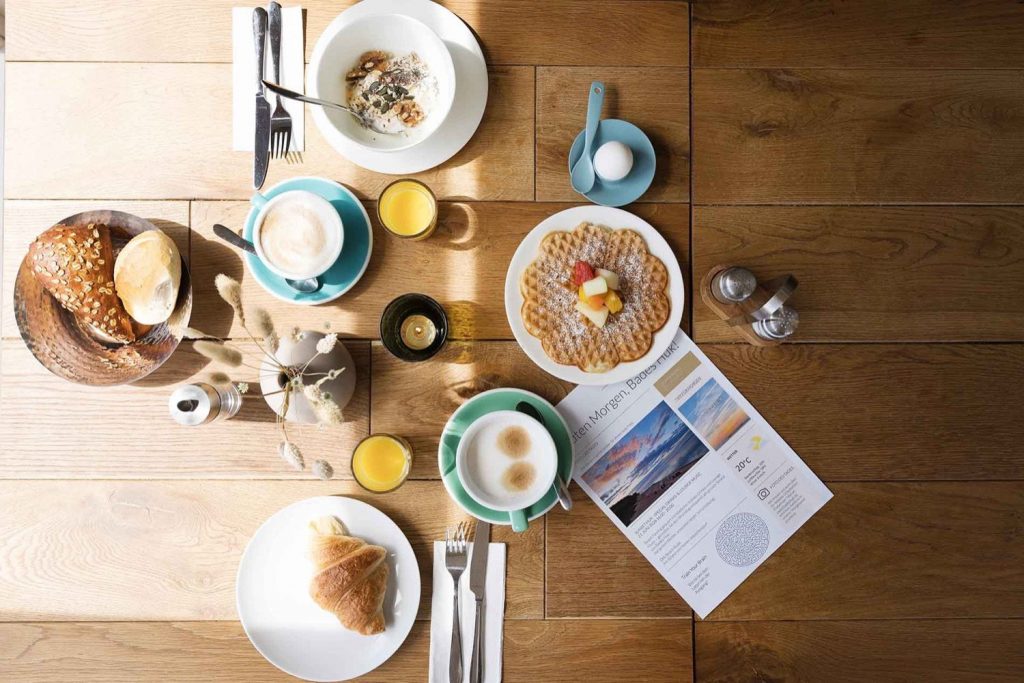
Honeycomb honey is considered a very special delicacy. Not only does the honeycomb look impressive on the breakfast table, but you’re also getting a high-quality piece of nature from Bades Huk—pure and unadulterated in flavor. Comb honey is a completely untreated, all-natural honey, as the bees seal the honey-filled cells of the comb with a thin layer of wax all on their own. This is called “capping.” Guests can find the honeycomb, for example, at the breakfast buffet in the Marina Café by the sea and take a piece for their roll, or let the honey that has dripped from the comb flow into a glass to add just the right amount of sweetness to their granola, for instance.
Flower Pollen – A Natural Product and Superfood
They are considered a particularly nutrient-rich food—essentially a superfood—because they contain many healthy components: pollen. Bees collect pollen from the stamens of plant flowers and, as they travel from flower to flower on their foraging trips, form pollen baskets on their hind legs. Pollen is rich in proteins, amino acids, and many other important nutrients. Pollen pairs particularly well with dairy products such as yogurt and quark, as well as in muesli, since these foods promote the absorption of its nutrients in the digestive tract.